

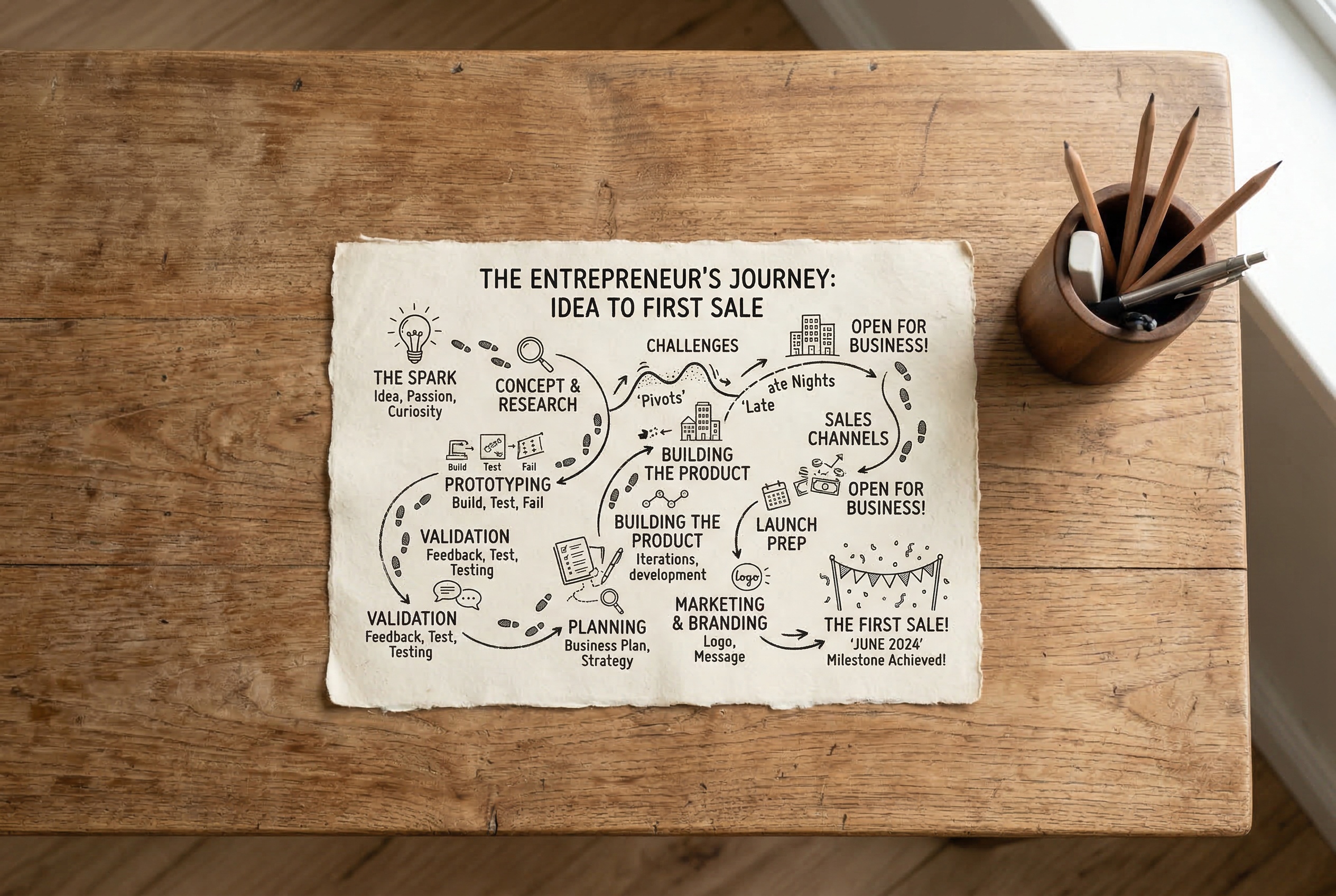
Most people who want to start a business don’t fail because the idea was bad. They fail — or never start at all — because nobody ever gave them a clear picture of what the journey actually looks like from day one. So they read ten blog posts, watch twenty YouTube videos, and end up more confused than when they started.
This post is meant to fix that. It is an honest, ground-level entrepreneurship guide for someone who has an idea but hasn’t done anything with it yet. No motivational speeches. No “mindset unlocks.” Just a clear map of what entrepreneurship actually involves, what to do first, and how to get from an idea on paper to an actual paying customer.
Let’s get into it.
What Entrepreneurship Actually Involves — Before You Do Anything Else
Before you take a single action, it helps to have a realistic picture of what you’re signing up for. Entrepreneurship — in plain terms — means building and running a business that creates value for customers and generates income for you. That’s it. There’s no mystical transformation required. No MBA. No investor backing. No viral moment.
What there is: a series of decisions, experiments, and adjustments. And the earlier you accept that, the better your odds of sticking with it long enough to see results.
The Two Paths: Starting vs. Buying
Most people assume entrepreneurship means starting something from scratch. That’s one path — and the one this guide focuses on. But it’s worth knowing that buying an existing business is a legitimate alternative. Buying an existing operation means you inherit customers, cash flow, and processes from day one. It comes with its own risks and a higher upfront cost, but for someone who wants to skip the early chaos, it’s worth understanding. For now, if you’re starting from nothing, keep reading.
Service Business vs. Product Business — Know the Difference
One of the earliest decisions you’ll make is whether you’re building a service business or a product business. This isn’t just a philosophical question — it changes everything about your timeline, your startup costs, and how quickly you can get paid.
A service business means you’re selling your time, skills, or expertise. A freelance copywriter, a lawn care company, a bookkeeper working from home — these are all service businesses. You can start one with almost no upfront money. In many cases, you can have your first paying customer within two weeks of deciding to start. If you want examples of what this looks like in practice, this list of profitable service business ideas is a useful starting point.
A product business means you’re selling a physical or digital item. Products require inventory, manufacturing, or development time. They usually take longer to launch and cost more to start. That doesn’t make them worse — but if you’re starting with limited time and money, a service business is almost always the faster, lower-risk entry point.
For the purposes of this guide, most examples will lean toward service businesses. They’re the most accessible starting point for beginners, and the lessons apply to product businesses too.
What to Expect Early On
The early stage of a business is not glamorous. Most of your time will be spent figuring things out, not executing with confidence. You’ll make decisions without full information. You’ll second-guess yourself. You’ll talk to potential customers and hear things you didn’t want to hear. All of that is normal. If you want the unfiltered version of what this looks like, this post on the brutal truths about entrepreneurship covers what most guides leave out.
The goal of this guide is not to scare you off — it’s to make sure you go in clear-eyed. That clarity is what keeps people going when things get uncomfortable, and they will.
Validating Your Idea Before You Build Anything
Here’s a very common mistake: someone spends three months building a website, designing a logo, and setting up social media accounts — and then discovers nobody wants what they’re selling. All that work, and zero validation that the idea was worth pursuing.
Validation is the process of confirming that real people have a real problem, and that they’re willing to pay someone to solve it. You do not need a finished product to validate. You need conversations and evidence.
Start With the Problem, Not the Product
The most durable businesses are built around problems people already have — not products people might someday want. Before you go any further, ask yourself: what specific problem does my idea solve, and for whom? Be precise. “I want to help small businesses with marketing” is not a problem statement. “Local restaurants in my area spend money on social media but never post consistently because the owner is managing everything alone” is a problem statement.
Once you’ve named the problem, talk to people who have it. Not your friends and family — they’ll be supportive in ways that aren’t useful. Talk to people who match your target customer profile. Ask them how they currently deal with the problem, what it costs them (in time, money, or stress), and whether they’ve ever paid for a solution. The U.S. Small Business Administration’s market research guide is a solid free resource for structuring this process.
Simple Validation Before You Spend a Dollar
There are a few low-cost ways to test whether an idea has legs before you commit to it. One is a landing page test — create a simple one-page site that describes your offer and includes a call to action (like “Join the waitlist” or “Request a quote”). Drive a small amount of traffic to it, either through social media or by sharing it directly with people you’ve identified as potential customers. See how many people respond. You don’t need a finished product — just a clear description of what you’re offering and who it’s for.
Another approach is to simply offer the service informally before you officially launch. If you want to start a social media management service, reach out to three local businesses and offer to manage their Instagram for one month at a reduced rate in exchange for a testimonial. If they say yes, you’ve validated the idea. If nobody bites, that’s feedback worth having now, not after you’ve spent money on branding.
When to Stop Validating and Start Building
Validation doesn’t have to take forever. Spending six months “doing research” before taking action is just fear wearing a productive mask. A reasonable validation window for a simple service business is two to four weeks. By then, you should have had at least five to ten real conversations with potential customers and received at least one signal of genuine interest — a request for pricing, an agreement to try your service, or someone referring you to someone else. That’s enough. Move forward.
The First Real Steps: From Idea to Structure
Once you’ve validated your idea, it’s time to set things up properly. This section covers the foundational decisions that will save you significant headaches later: your business structure, your name, your basic financial setup, and your plan.
Choosing a Business Structure
Your business structure is the legal framework your business operates under. It determines how you pay taxes, how much personal liability you carry, and how you can raise money down the road. For most beginners starting a simple service business, the two most common options are a sole proprietorship and an LLC.
A sole proprietorship is the default. If you start offering a service and getting paid without registering anything, you’re automatically operating as a sole proprietor. It’s simple, costs nothing to set up, and works fine for very early testing. The downside: your personal assets — savings, car, home — are legally exposed if something goes wrong with the business.
An LLC (Limited Liability Company) creates a legal separation between you and your business, which protects your personal assets. It costs between $50 and $500 to form depending on your state, and it signals to clients that you’re operating seriously. For most people reading this, forming an LLC is the right move early — not immediately, but once you have your first paying client or two. This walkthrough on how to create an LLC will show you exactly how it’s done.
Your EIN, Bank Account, and the Financial Foundation
Two things you’ll want to set up early — even if they feel premature — are your EIN and your business bank account.
An EIN (Employer Identification Number) is essentially a Social Security number for your business. It’s free to get from the IRS, takes about ten minutes online, and you’ll need it to open a business bank account, file taxes, and in some cases, work with clients.
A business bank account keeps your business money separate from your personal money. This is not optional if you’re serious. Mixing the two creates a mess that becomes expensive at tax time and makes it nearly impossible to understand how your business is actually performing. If you’re working from home — which most beginners are — also take a few minutes to understand your local requirements around licensing, since some municipalities require a permit even for home-based operations.
Writing a Basic Business Plan
The words “business plan” tend to trigger one of two reactions: either someone goes and writes a 40-page document nobody will ever read, or they skip it entirely because it sounds too formal. Neither is right.
A basic business plan for a beginner is a one to two page document that answers four questions: What problem do I solve? Who am I solving it for? How do I make money? What does it cost me to deliver? That’s it. It forces you to think clearly before you act, and it gives you something to pressure-test as you learn more.
Your plan is not a contract with the universe. You’ll revise it. But having one — even a rough one — keeps you from making decisions that contradict each other or drift from your original purpose. The SCORE business plan template for startups is a free, well-structured resource if you want a starting framework.
Getting Your First Customers — The Part Nobody Makes Easy Enough
Everything up to this point has been setup. This is where most people stall, because getting customers requires doing something uncomfortable: putting yourself out there before you feel fully ready. The hard truth is that you will never feel fully ready. The only way to get your first customers is to ask for them.
The Fastest Path to a First Sale
The single fastest path to a first paying customer — for almost any service business — is your existing network. Not strangers on social media. People who already know you. Former colleagues, neighbors, friends who run small businesses, people in community groups you’re part of. Tell them specifically what you’re doing and who you help. Ask if they know anyone who might need it.
This feels awkward, especially the first time. But consider the alternative: spending three months building an audience from scratch while your bank account drains. I’ve watched too many people take that route when they had five people in their contact list who could have sent them their first client the same week. Start with the people who already trust you. For a structured approach to landing those first clients without a budget, this post on getting your first ten customers with zero budget is worth bookmarking.
Pricing: Don’t Underprice Yourself Out of Sustainability
Pricing is one of the decisions that sinks new business owners before they even realize what happened. The instinct when you’re new is to charge as little as possible to attract customers. The problem is that underpricing doesn’t just hurt your income — it attracts clients who will be difficult to work with, and it makes your business unsustainable before it ever gets going.
Price based on the value you deliver, not on what you think people will pay for a beginner. Research what others in your space charge. Factor in the time it takes to deliver, plus the overhead you’ll carry. Then add a margin that lets you stay in business. This honest pricing framework for service businesses will walk you through it without the guesswork.
Funding: Bootstrapping vs. Outside Investment
For most beginners starting a service business, the funding question is simpler than it seems. You don’t need investor money to start a service-based operation. In most cases, you need a laptop, a phone, and a handful of clients. That’s bootstrapping — funding your business through your own savings and early revenue, without taking on outside investment.
Outside investment — from venture capital, angel investors, or even small business loans — comes with tradeoffs. You may give up equity (ownership), take on debt, or be held to someone else’s timeline for growth. For a solo service business in the early stage, this is rarely necessary or wise. If you’re still working a day job while building this, that’s the smart move for most people — keep that income until the business can replace it.
What to Learn — and When to Consider Formal Education
You don’t need a degree to start a business. But you do need to learn certain things, and the question is how. Some people learn by doing, which works well for operations and client management. Others benefit from structured learning, particularly for finance, legal, and strategy.
The Case for Learning as You Go
The most valuable education for a first-time business owner is usually experience. Reading a book about pricing is useful. But actually pricing a service, losing a client because you charged too much, and adjusting — that teaches you something a textbook can’t. Most of what you need to know in the early stage can be learned from free resources, targeted articles, and conversations with people who have done it before.
Finding a good mentor early makes a real difference. Not someone who charges $2,000 for a coaching package, but someone who has actually run a business similar to what you’re building and is willing to share what they learned.
One area where beginners consistently underinvest is finance. Understanding how to read a profit and loss statement, how cash flow differs from profit, and how to build a basic budget will save you from the mistakes that quietly kill businesses that look like they’re doing fine. Khan Academy’s free accounting and finance courses are an underrated starting point for anyone intimidated by numbers. The IRS Small Business and Self-Employed Tax Center is also worth bookmarking early — understanding your tax obligations before you need to file is far less painful than figuring it out after the fact.
When a Formal Program Might Actually Be Worth It
There are situations where structured entrepreneurship education adds real value. If you want to build a scalable technology company, seek funding, or eventually manage a larger team, a formal program can accelerate your learning and expand your network in ways that organic experience might not. The cost of business education varies enormously — there are accredited programs that deliver strong practical outcomes at a fraction of the cost of well-known names, and for someone running a small business, the curriculum overlap with real operations often matters more than the brand on the diploma.
That said — for most people reading this guide — formal education is not the next step. The next step is starting. Everything else can follow.
The Skills You’ll Build Whether You Want To or Not
Once you’re in it, you’ll develop skills faster than you expect. You’ll get better at selling because you’ll have to. You’ll get better at managing your time because evenings and weekends don’t stretch. You’ll learn how to handle difficult clients, how to invoice without chasing payment, and how to make decisions without certainty.
The learning doesn’t stop when you get your first client. It shifts. You go from learning how to start to learning how to run and grow — and at that point, resources on marketing, accounting basics, and financial literacy become tools you’ll actually use rather than things you’re reading to prepare.
The Short Version of Everything Above
Entrepreneurship is not a personality type or a gift. It is a series of decisions made with incomplete information, corrected over time by paying attention. The people who succeed are not always the most creative or the most confident — they’re the ones who started, learned from what happened, and kept adjusting.
Here’s what this guide has covered, compressed:
Decide what you’re building — service or product, scratch or acquisition. Validate the idea before you spend money on it. Set up your legal and financial foundation early, even when it feels premature. Write a simple business plan. Price your service properly. Get your first customers through your existing network before you build an audience from scratch. Learn the financial basics so you know whether the business is actually working. And decide whether any formal education fits your situation — but don’t use it as a reason to delay starting.
That’s the map. The territory will surprise you. It always does. But having the map means you spend your energy adapting to what’s real, not searching for a place to begin.
Start This Week, Not Next Month
Everything in this entrepreneurship guide points to one thing: action taken now is worth more than a perfect plan taken later. You don’t need everything figured out. You need the next right step.
Take twenty minutes today and write down your idea in three sentences: the problem you’re solving, who has it, and how you plan to get paid for solving it. Then identify three people in your life who fit your target customer profile, and reach out to one of them this week — not to sell, just to have a real conversation about the problem you’re trying to solve. That conversation will tell you more than another week of research.
The difference between someone who launches a business and someone who talks about it for years is not talent, connections, or money. It’s whether they took the first step before they felt ready.

