What Business Financial Statements Actually Are (And Why Most People Ignore Them)
You open an email from your bookkeeper. Attached are three documents. You scroll through them, nod like you understand what you are looking at, and then close the tab. Sound familiar?
You are not alone in that. Most people who are new to running a business treat their financial reports like terms and conditions — something generated by professionals, stored somewhere, and never actually read. The problem is that these three documents are the closest thing to a health checkup your business will ever get. And if you are not reading them, you are flying without instruments.
Here is the good news. You do not need an accounting degree to understand business financial statements. You just need to know what question each one is designed to answer. Once you have that, the numbers start to make sense fast.
There are three core financial statements every small business owner should know: the income statement, the balance sheet, and the cash flow statement. Each one tells you something different. And each one, on its own, gives you an incomplete picture. This post is about learning to read all three — and understanding how they fit together.
One important note before we get into it: this is about reading and interpreting reports you already have. If you are trying to build a budget or forecast future spending, that is a separate skill covered in our small business budgeting post. These are two different jobs. This post is about understanding the scoreboard after the game has been played.
Why Most New Business Owners Avoid Their Financial Reports
There are two common reasons people avoid looking at their financials. The first is fear — if the numbers are bad, looking at them makes the problem real. The second is confusion — the reports look like they were designed for someone with a finance background, and nobody explained the basics in plain English. Both of those reasons are understandable. But avoiding your financials is exactly how small problems become expensive ones. A common version: an owner counts invoices that have been sent as if the money were already in, keeps spending against that number, and only finds out months later that much of it has not been collected. That is the kind of mistake these reports exist to prevent.
The Three Questions These Statements Answer
Here is the simplest frame you can use. Each financial statement answers one core question. The income statement asks: did the business make money during this period? The balance sheet asks: what does the business own and owe right now? The cash flow statement asks: where did the money actually come from and where did it go? Memorize those three questions. Every number on every report is trying to answer one of them. When you approach your financials with this framework, the documents stop looking like noise and start looking like information.
When You Need Accounting Software vs. a Spreadsheet
If you are generating these reports yourself rather than receiving them from a bookkeeper, this question matters. A spreadsheet can work when your business is very simple — you have one or two income sources, minimal expenses, and you are tracking everything manually in real time. But once you are dealing with invoices, multiple expense categories, contractors, or any kind of inventory, accounting software built for small businesses will generate these statements automatically from your transaction data. The advantage is accuracy and time savings. The disadvantage is a learning curve and a monthly cost. Most people running a business beyond the earliest stage find the software pays for itself quickly — not because it is fancy, but because it stops errors from compounding. Either way, the goal is the same: getting clean, reliable reports you can actually read and use.
The Income Statement: Did You Make Money?
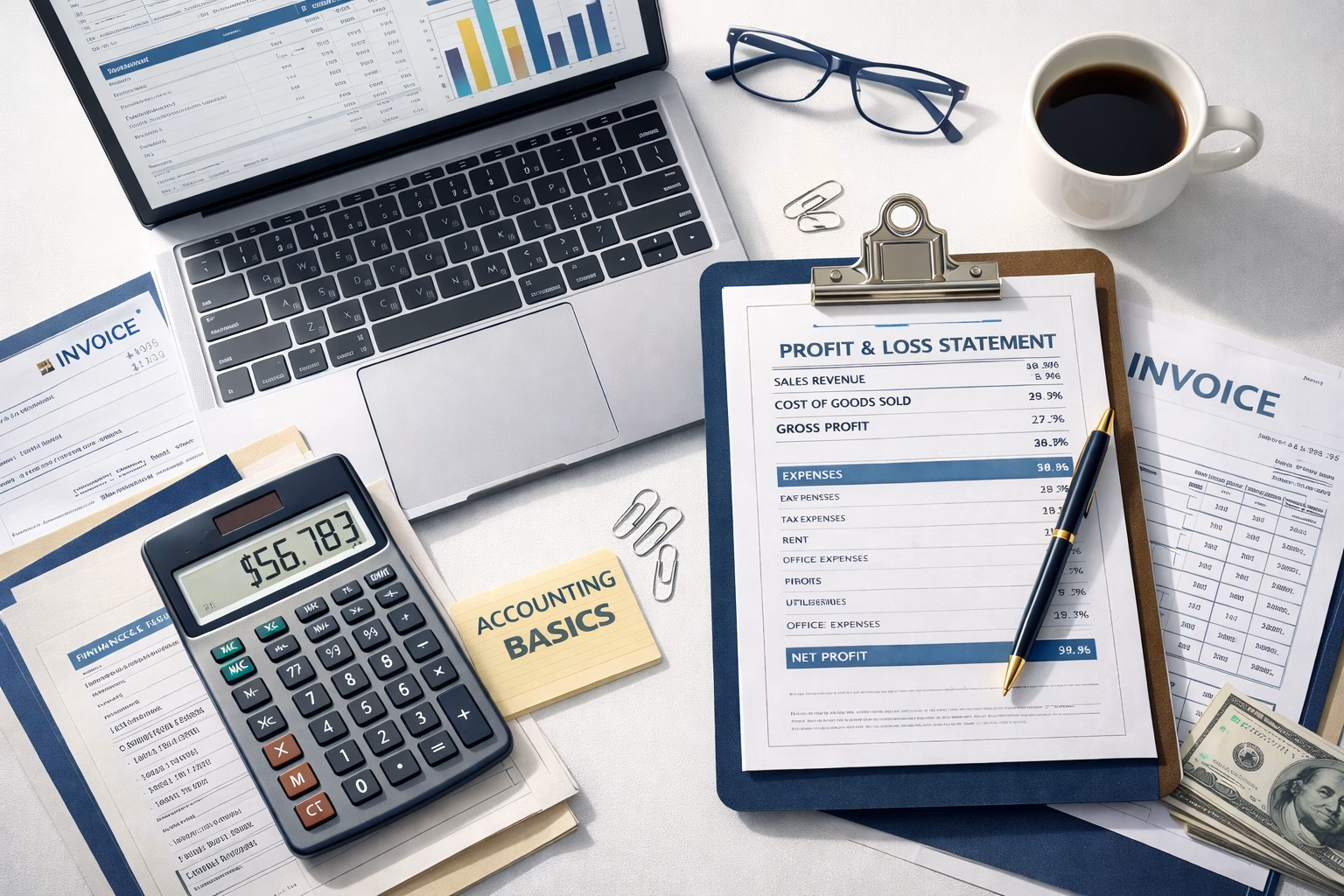
The income statement — sometimes called a profit and loss statement, or P&L — is usually the first report people look at. It covers a specific time period, like a month, a quarter, or a year. It tells you how much money came in, how much went out in expenses, and what was left over. That leftover amount is your net profit (if it is positive) or your net loss (if it is negative).
The basic structure looks like this. At the top, you have revenue — the total amount of money your business earned from selling products or services. Below that, you subtract your cost of goods sold (COGS), which is the direct cost of producing whatever you sell. The number you get after that subtraction is called gross profit. Then you subtract your operating expenses — things like rent, marketing, software subscriptions, and utilities. What remains after that is your operating income. Subtract taxes and any interest on debt, and you arrive at net income — the bottom line.
What the Income Statement Tells You
The income statement is your performance scorecard. It tells you whether your business model is working — whether you are bringing in more than you are spending over a given period. It also shows you where your costs are concentrated. If your gross profit looks healthy but your net income is low, your operating expenses deserve a closer look. If your revenue looks strong but your gross profit is thin, your cost of goods sold may be eating into your margin in ways that are worth addressing. You can use month-over-month or year-over-year comparisons on this statement to spot trends — revenue growing, expenses outpacing growth, or specific cost categories that keep climbing.
What the Income Statement Does Not Tell You
Here is the trap that catches a lot of people: the income statement can show a profit even when your bank account is empty. That sounds impossible, but it happens regularly. The reason is that the income statement records revenue when it is earned, not necessarily when it is collected. If you invoiced a client for $5,000 in March and they have not paid yet, that $5,000 still shows up as March revenue on your income statement. On paper, you made money. In reality, you do not have the cash yet. This is called accrual accounting — it is the standard method for most businesses, and it is accurate in the long run, but it means you cannot rely on your income statement alone to understand your cash position. That is what the cash flow statement is for.
One Common Misread to Avoid
The most dangerous misread on an income statement is confusing revenue with profit. Revenue is the total coming in before anything is subtracted. Profit is what is left after everything is paid. A business can have impressive revenue and thin or negative profit. If you are only glancing at the top line number — the total revenue figure — you are missing the whole story. Always follow the numbers down to net income before drawing any conclusions about how the business is performing.
The Balance Sheet and Cash Flow Statement: The Full Picture
Once you understand the income statement, the other two documents start to make more sense. The balance sheet and the cash flow statement answer the questions your P&L cannot. Together, all three give you what a single report never could: a real, complete view of your business’s financial health.
Reading the Balance Sheet
The balance sheet is a snapshot — not a period of time like the income statement, but a single moment. It shows what your business owns (assets), what it owes (liabilities), and what is left over for you as the owner (equity). Assets include things like cash in your business checking account, money owed to you by clients (called accounts receivable), equipment, and inventory. Liabilities include money you owe — loans, unpaid bills, credit card balances, and anything else the business owes to someone else. Equity is what remains when you subtract liabilities from assets. It represents your ownership stake in the business. The balance sheet is called a balance sheet because the two sides of the equation always balance: assets always equal liabilities plus equity. If your software generates a balance sheet that does not balance, something is wrong in your records. The balance sheet is especially useful for understanding debt load, how much working capital you have, and whether the business is in a position to take on new obligations — like a loan or a lease.
Reading the Cash Flow Statement
The cash flow statement is the one most people skip, and it is often the most important. Where the income statement tells you if you made money, the cash flow statement tells you if you actually have it. It tracks the movement of real cash in and out of your business across three categories. Operating activities cover the day-to-day cash flows from running the business — collecting payments from customers, paying suppliers, paying employees. Investing activities cover cash spent on or received from long-term assets — buying equipment, for example, or selling a piece of property. Financing activities cover cash related to debt and ownership — taking out a loan, repaying a loan, or an owner putting money into the business. The number to pay close attention to is called free cash flow — roughly, the cash generated from operations after covering necessary capital expenses. This is the number that tells you whether your business is generating real, usable cash or just accounting profit. For more on how your business bank account connects to your cash position, our business checking account guide covers the setup side of that equation.
How the Three Statements Work Together
Reading any one of these documents in isolation is like reading one chapter of a book and thinking you understand the plot. They are designed to be read together. A business might look profitable on the income statement but be cash-poor because clients are slow to pay — the cash flow statement will show that. A business might show strong cash balances but carry so much debt that equity is nearly zero — the balance sheet reveals that. The income statement shows you direction and performance. The balance sheet shows you stability and position. The cash flow statement shows you reality. When all three tell a consistent, healthy story, you are in good shape. When one of them contradicts the others, that is where the real information is. That contradiction is the thing worth investigating.
How to Actually Use These Reports Without Feeling Overwhelmed
Knowing what these statements contain is one thing. Making them part of your regular routine is another. Most people who run small businesses do not sit down with their financials until tax season forces them to — and by then, the useful window for acting on what they find has often closed. The goal is to shift from reactive to regular.
Build a Simple Monthly Review Habit
You do not need to analyze every line item every month. A simple monthly review covers three things: check your net income on the income statement, check your cash balance and operating cash flow on the cash flow statement, and scan your balance sheet for any liabilities that have grown unexpectedly. That review can take fifteen minutes if your books are clean and current. What you are looking for are changes — things moving in directions you did not expect or do not understand. Those are the signals worth investigating further, either on your own or with a bookkeeper or accountant.
Know When to Ask for Help Reading Them
There is no shame in reading a report and not understanding a line item. The smart move is to ask. If you have a bookkeeper, they should be able to walk you through anything that looks unfamiliar. If you are doing your own books using accounting software for beginners, most platforms include built-in explanations or tooltips next to each report. What matters is that you are actively engaging with the numbers rather than filing the reports away unread. The business owners who make consistently good decisions are not necessarily the ones who understand accounting deeply — they are the ones who know enough to ask the right questions when something does not add up.
Link What You Read to Decisions You Need to Make
Financial statements are not scorecards you read for their own sake. They exist to inform decisions. Should you hire someone? Check whether cash flow from operations supports the additional payroll. Should you take on a large client project that requires upfront materials cost? Check your balance sheet to see if you have the working capital to float it. Thinking about adjusting your pricing? Run your income statement before and after a hypothetical price change to model the impact. The reports become useful the moment you connect them to a real question you are trying to answer. That connection is what turns accounting into strategy.
Before You Close This Tab and Leave These Reports Unread Again
Reading business financial statements is not about becoming an accountant. It is about knowing what three questions to ask — did you make money, what do you own and owe, and where did the cash actually go — and knowing which document answers each one. Together, those three reports give you more useful information about your business than almost anything else you could look at.
This week, pull up the most recent financial statements you have — whether from your bookkeeper, your accounting software, or your own records. Open the income statement and find your net income. Open the cash flow statement and find your operating cash flow. Look at whether those two numbers are telling the same story or a different one. If they are different, that gap is the most interesting thing in your financials right now.
The difference between a business owner who makes confident decisions and one who feels like the numbers are always a mystery is not talent — it is just the habit of actually looking.
This article is general information, not legal, tax or financial advice. See the Disclaimer.